Photosynthesis
- STEMinnovista

- Apr 3, 2024
- 2 min read
Photosynthesis is a process that occurs in all plants, including bacteria and algae. They utilize the energy provided by the sun to produce energy in the form of glucose and oxygen. The process of photosynthesis includes light energy being absorbed by the plants and synthesized with carbon dioxide (CO2) and water (H2O) and gets converted into glucose (C6H12O6) and oxygen (O2).
In chemical terms, photosynthesis is a light-energized oxidation–reduction process.

Photosynthesis plays a critical role in sustaining life on Earth. If photosynthesis ceased, there
would soon be little food or other organic matter on Earth. Most organisms would disappear, and eventually Earth’s atmosphere would become nearly devoid of gaseous oxygen. Under these circumstances, only chemosynthetic bacteria would be able to survive. These organisms can utilize the chemical energy from certain inorganic compounds, allowing them to thrive without relying on the conversion of light energy.
While there are many steps behind the process of photosynthesis, it can be broken down into
two major stages: light-dependent reactions and light-independent reactions.
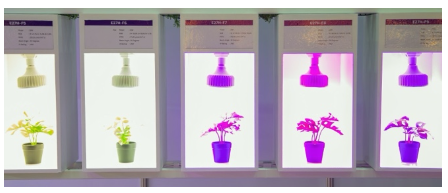
Light is essential for every plant. So, do the different colors of light impact the rate of
photosynthesis?
Plants demonstrate their highest efficiency in photosynthesis when exposed to white light,
encompassing all wavelengths. Although plants absorb light across the spectrum, certain colors have varying impacts on different plant species (Sanchez, 2014). With chlorophyll present in plant cells, they absorb all light while reflecting green light (French, 2014). Thus, various light colors influence both photosynthesis and respiration rates.
The efficiency of photosynthesis, as well as plant growth and development, are influenced by the color of light. LED lights commonly contain red, blue, and far-red LEDs, leading to the perception that these colors are ideal for plant growth. However, it's essential to differentiate between the impact of light color on photosynthesis and its effect on development.
Red LEDs typically produce the highest light output per kilowatt of electricity, making them
dominant in lighting fixtures. Although plants cannot thrive solely on red light, blue and sometimes far-red light are also incorporated. Nonetheless, plants can effectively utilize other light colors, as demonstrated by the McCree curve, which shows peaks in red and blue but non-zero levels of photosynthesis in other colors.
LED lighting has already facilitated the growth of leafy crops and some green pot plants, but
flowering ornamental plants remain challenging to cultivate under LED light. Despite advancements, sunlight, with its full spectrum of colors, remains superior for plant growth, as confirmed by numerous trials.
Sunlight comprises UV, PAR (photosynthetically active radiation), and infrared. Only PAR is crucial for growth, while infrared contributes to greenhouse heating. As infrared is not necessary for photosynthesis.
Light color significantly influences crop development, affecting factors like elongation, branching, and flowering timing. Even minor differences in light color can have a significant impact on development, such as a small amount of red light keeping chrysanthemums vegetative during long nights. The ratio of different light colors, like red to far red or red to blue, plays a key role in regulating plant characteristics such as compactness and stem length.
To sum up, yes, light plays a crucial role in influencing the rate of photosynthesis.




Comments